Transnational Exhibition on Roma Memory, Resilience, and Youth Voices
Mangan Devles Te avel bahtalipe Te nameren e chavore E phure te dojuven pesko viko Kai te na daras pala pesco juvimo Pala kotor marno Pala vujo pai
What can a palm reveal?
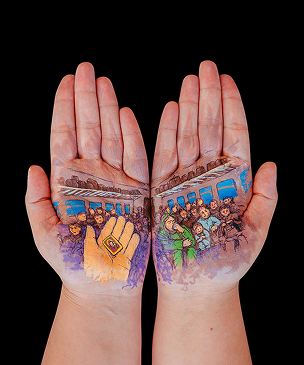
For centuries, it has been read as a tool of fortune-telling, burdened by exoticized stereotypes about Roma. At the heart of this exhibition lies an act of creative reclamation of that metaphor. Today’s Roma youth transform their hands into living archives, carrying stories literally inscribed upon them. They embed testimonies of Holocaust survivors and interweave them with their own reflections on war, displacement, and hope. It is a powerful gesture of reclaiming voice: where once there was stereotype, there now stands testimony — authored not about them, but by them.
This work was preceded by months of research and in-depth interviews, uncovering stories not only of loss but of extraordinary resilience and solidarity. In a shared art laboratory, these narratives came alive in a unique way: while participants listened to testimonies, four artists simultaneously painted on their palms. It was a process of immersion — listening, remembering, and giving form to memory at once.
What can a palm reveal?
For centuries, it has been read as a tool of fortune-telling, burdened by exoticized stereotypes about Roma. At the heart of this exhibition lies an act of creative reclamation of that metaphor. Today’s Roma youth transform their hands into living archives, carrying stories literally inscribed upon them. They embed testimonies of Holocaust survivors and interweave them with their own reflections on war, displacement, and hope. It is a powerful gesture of reclaiming voice: where once there was stereotype, there now stands testimony — authored not about them, but by them.
This work was preceded by months of research and in-depth interviews, uncovering stories not only of loss but of extraordinary resilience and solidarity. In a shared art laboratory, these narratives came alive in a unique way: while participants listened to testimonies, four artists simultaneously painted on their palms. It was a process of immersion — listening, remembering, and giving form to memory at once.
What you see before you are not merely drawings
Each work is a dialogue. The image on the palm speaks to the text beside it, while the QR code invites you to hear the living voice, plunging deeper into personal experience. A conscious choice was made to involve not only Roma but also non-Roma youth in this process, for the stories themselves revealed how deeply intertwined these destinies were. This shared act became a space where empathy dissolved prejudice, where participants carried the imprints of history upon their own bodies, building bridges of understanding as they did so.
The exhibition confronts difficult questions of intergenerational trauma. What does a young person feel when seeking refuge from war in the very countries that once sought to annihilate their ancestors? What imprint will these events leave on the identities of future generations? The project does not offer answers; instead, it invites a careful dialogue with these unsettled realities.
What you see before you are not merely drawings
Each work is a dialogue. The image on the palm speaks to the text beside it, while the QR code invites you to hear the living voice, plunging deeper into personal experience. A conscious choice was made to involve not only Roma but also non-Roma youth in this process, for the stories themselves revealed how deeply intertwined these destinies were. This shared act became a space where empathy dissolved prejudice, where participants carried the imprints of history upon their own bodies, building bridges of understanding as they did so.
The exhibition confronts difficult questions of intergenerational trauma. What does a young person feel when seeking refuge from war in the very countries that once sought to annihilate their ancestors? What imprint will these events leave on the identities of future generations? The project does not offer answers; instead, it invites a careful dialogue with these unsettled realities.
Memory Bridges reminds us that the wounds of the past do not vanish; they grow roots into the present.
Yet this exhibition is not only about pain. It is about the strength that emerges when one generation dares to listen to another. We sought to create a space of empathy, where — in looking at these palms — you cannot know whether they belong to a Roma, a Ukrainian, a Jew… You will see first and foremost a Human Being, and their story. Each testimony gathered here is also preserved in the Droma Digital Archive — a time capsule for the future.
We invite you to walk across these bridges of memory, to look closely at these imprints of lives, and to reflect: how do we listen to the stories of others, and what do we do to ensure they are never forgotten?
Curators: Tetiana Storozhko, Artur Ivanenko
Why It Matters
Memory Bridges is more than an exhibition — it is an act of remembrance and resistance. By weaving together oral history, contemporary refugee testimonies, and youth-created art, the project highlights the continuity of Roma struggles across generations. It shifts the narrative from invisibility to agency, reminding us that Roma history is not marginal but integral to Europe’s collective memory.
The palms inscribed in this exhibition carry more than drawings. They carry voices silenced by genocide, cries of displacement, and visions of survival. Each testimony becomes both a fragile trace of the past and a powerful resource for the future.
Through art, memory, and dialogue, Memory Bridges invites audiences to listen, reflect, and act. It shows that remembrance is not passive commemoration — it is a living force for empathy, education, and collective resistance.
A Road Through Time: Voices Walking the Same Path of Memory
The art video “A Road Through Time” is a symbolic journey where the voices of people, separated by decades, follow a single path of memory. The video is centered on a creative reimagining of the palm: casting aside the stereotype of fortune-telling, the project reframes it as a personal and collective map of memory, where what is “read” is not the future, but lived experience. By blending the act of drawing on palms with memories and dreams, the film guides the viewer along a path from the anticipation of war, through escape and loss, to moments of human kindness, and finally, to the preservation of identity and shared dreams for the future.
Memory Bridges: 10 Stories, 10 Destinies
Each palm presented below is a bridge between the past and the present. Each drawing is a dialogue with a story heard, felt, and transformed into a living testimony. We invite you to look closely and listen to the silent conversations held in these hands.
Behind every imprint of memory lies a deep creative process. To learn how we collected testimonies, worked in the art laboratory, and built bridges between generations, please visit the project page.
This exhibition would not have been possible without the courage of those who shared their stories. We honor all voices — from the survivors of the Roma genocide to the Roma youth of today. Some spoke openly, others chose anonymity, yet every testimony resonates with equal force. Their words remind us that memory is both fragile and enduring, carried across generations as a legacy of truth.
We bow to the survivors whose testimonies have reached us even when they are no longer here to speak. Through their words, they remain present, urging us never to forget.
We express our deep gratitude to the Ukrainian Center for Holocaust Studies for preserving these testimonies and sharing them with us. Their work ensures that remembrance lives on, safeguarded for future generations.
We are equally grateful to the Roma youth who, despite the hardships of war and displacement, chose to share their own experiences. Their strength proves that remembrance is not only about the past but also about resilience in the present and hope for the future.
To the artists who gave form and color to these voices — your hands transformed silence into image, and memory into art. Each palm painted is more than a drawing: it is a bridge between history and humanity.
We thank our partners and supporters whose solidarity made this project possible. Their commitment shows that remembrance is never a solitary act, but a shared responsibility.
Finally, we thank every visitor and reader of this catalogue. By engaging with these testimonies and artworks, you too become part of the bridge — carrying memory forward, standing against silence and injustice, and affirming the dignity of every human story.
Dedication
This exhibition is dedicated to all Roma who suffered and perished during the Holocaust, and to those whose lives continue to be torn apart by war and displacement today.
We honor the memory of the victims. We celebrate the resilience of the survivors. We stand with Roma youth who carry these stories forward, transforming silence into voice and memory into action.
Behind the Scenes
Tetiana Storozhko
Lead Curator
Artur Ivanenko
Co-Curator
Uliana Ustinova
Facilitator
Serhii Kamforovych
Artist
Olena Kukhar
Designer
Solomiia Dziuba
Artist
Anna Skoriak
Artist
The project “Memory Bridges: A Creative Dialogue Between the Past and Present of the Roma Community” is supported by the European Union under the House of Europe programme.
Funded by the European Union
For authorizations, contacts or specific uses, please write to info@kaidikhas.com