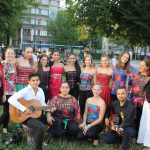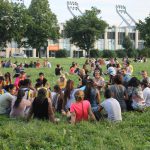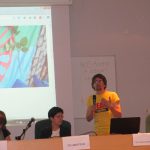

On August 2nd of this year, the International Roma Youth Network Ternype gathered approximately 1,000 young Roma and non-Roma individuals representing over 25 countries in Krakow to participate in events dedicated to the 70th anniversary of the “Gypsy Night” – the mass extermination of Roma in Auschwitz-Birkenau.
Tetyana Storozhko took part in the event as a member of the Ukrainian delegation led by scholar and researcher Mykhailo Tyahlyi, a staff member of the Ukrainian Center for Holocaust Studies.
The program included a two-day academic conference, a series of educational seminars and trainings, meetings between participants and former prisoners of the death camp, as well as a trip to Auschwitz where a solemn ceremony was held to mark the 70th anniversary of the liquidation of the “Zigeunerlager” (Gypsy Camp), along with a museum tour.
During the aforementioned events, the organizers placed special emphasis on the meetings and interactions between young people and Roma individuals who had experienced imprisonment in the camp. This provided an opportunity not only to learn about historical facts but also to gain a closer, more emotional experience and a better understanding of the conditions in which the Roma people lived during World War II. In addition to creating a space for sharing experiences, this intergenerational dialogue aimed to fill the void that has been present in historical research over the past seventy years. We also hope that this dialogue will motivate young participants to activate their efforts in the field of oral history research and collect the memories of survivors within their communities. During roundtable discussions, participants actively engaged in discussing the significance of genocide memory and the role of the younger generation in preserving and constructing collective memory.
Conference
The International Conference “Education for the Preservation of Romani Genocide Memory,” which took place from July 31st to August 1st, 2014, brought together approximately 80 experts and representatives of interested NGOs. They discussed strategies for commemorating the victims of the genocide and shared successful practices and educational resources. One of the conference’s objectives was to promote collaboration among researchers, experts, journalists, educators, and especially Roma and their youth organizations.
The necessity to address these issues is driven by objective reasons since the Romani genocide remains unrecognized in many countries and formal and non-formal educational institutions, which prevents the use of educational resources primarily for the younger generation.
For instance, an educational project implemented at the Ethnographic Museum in Tarnów serves as a worthy example to follow. It features the world’s first permanent exhibition dedicated to the history and culture of the Roma people. Regular meetings of Roma children (as well as their non-Roma peers) take place here, providing them with a direct connection to the heritage of their ancestors and the opportunity to realize their belonging to a distinct nation. Simultaneously, they grow in the eyes of their peers, who discover that they, too, have their own history and rich culture.
Historia magistra vitae
According to Tetyana Storozhko, the most significant and valuable outcome of this event was the invaluable opportunity that each participant received – the chance to comprehend and realize what Auschwitz represents not only for the community but also for themselves personally.
In this context, the words of Dragan Radosavljević, the President of the NGO “Voices of Minorities” (Serbia), speak volumes:
“Auschwitz is not just one of the Nazi concentration camps where a group of prisoners suffered during the war. No, Auschwitz is the fraternal grave of the Romani nation; Auschwitz is the death and the end of the existence of the Roma people. Today, with tears in our eyes, we remember all those who did not have the opportunity to live until the next morning simply because they were Roma. Now, with sorrow and pain in our hearts, but with our heads held high, we move forward with pride as a nation – the Roma nation, which resisted the greatest evil and continued its journey along the paths of history.
Auschwitz is the largest grave of the Roma people, synonymous with suffering and death. Auschwitz is the greatest victory of our life, synonymous with Roma triumph and the existence of the Roma nation.”